
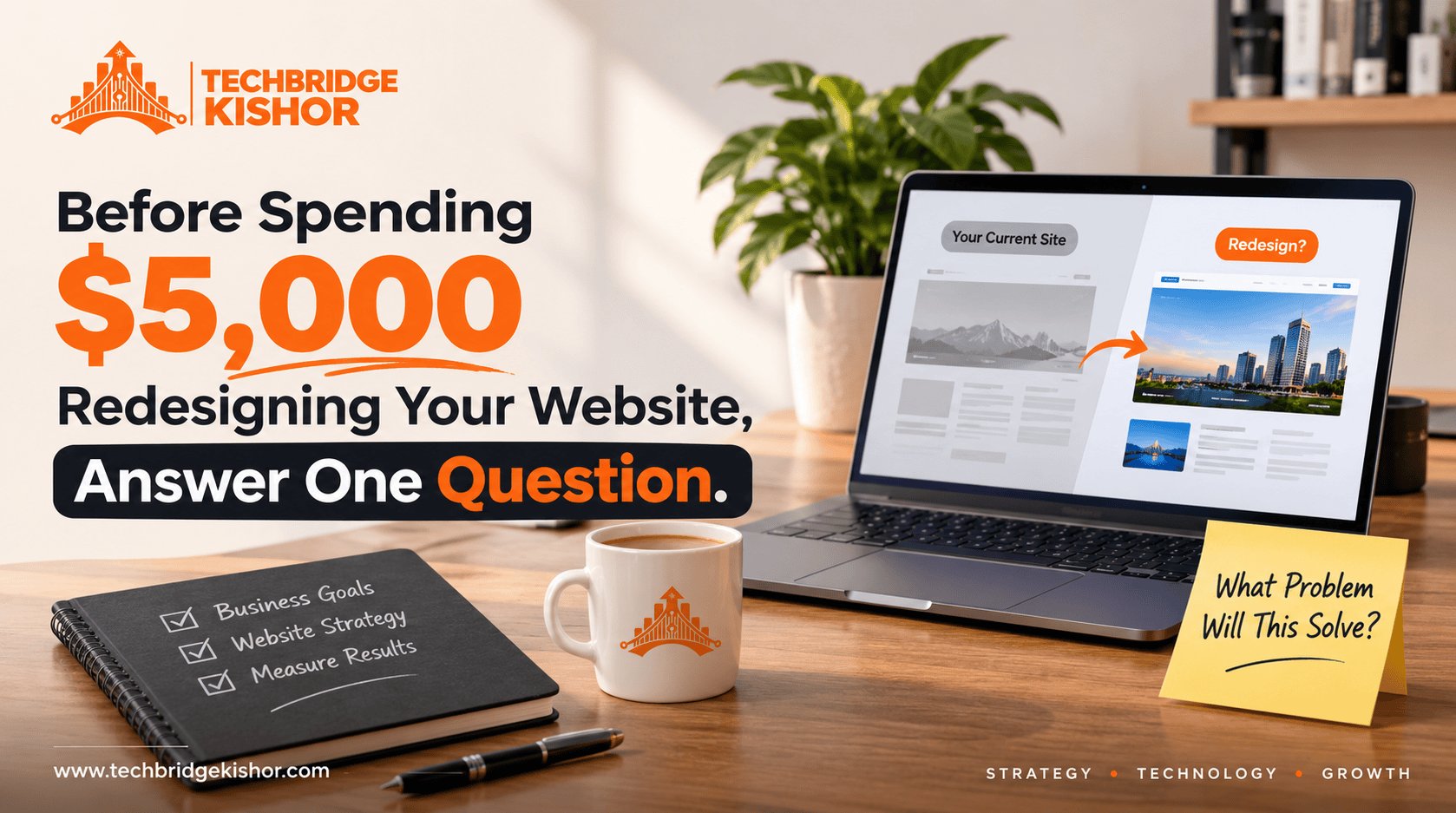
Does your business really need a new website, or does it need a better-performing one?
I’ve seen businesses consider a website redesign for familiar reasons.
The design looks outdated. Competitors have better-looking websites. The homepage needs refreshing. The overall experience doesn’t feel modern anymore.
And the obvious solution seems to be starting again.
But before investing $5,000 or more, I’d suggest asking one important question:
What specific business problem will this redesign solve?
Because a better-looking website doesn’t automatically mean more customers, better conversions or business growth.
A new design doesn’t guarantee better results.
Imagine a business invests thousands of dollars in a completely redesigned website.
It looks modern, loads smoothly and offers an impressive user experience.
But six months later, enquiries haven’t improved.
Why?
Perhaps visitors still don’t understand the company’s value. Maybe the messaging isn’t clear, the calls to action aren’t effective, or the enquiry process is unnecessarily complicated.
The problem wasn’t necessarily the design. It was the strategy behind the website.
A website should do more than represent your business online. It should help attract the right audience, build trust and encourage meaningful action.
5 things to evaluate before redesigning
Before approaching a designer or developer, consider these five questions:
1. Are you attracting the right audience?
More website traffic doesn’t always mean more business. Understand whether you’re attracting potential customers who actually need your products or services.
2. Is your message clear?
Can visitors quickly understand what you offer, who you help and why they should choose you?
3. Where are visitors dropping off?
Look at your important pages, enquiry forms, conversion rates and customer journeys. You might discover that a few targeted improvements could make a bigger difference than rebuilding everything.
4. Are your business systems connected?
What happens when someone submits an enquiry? Does it reach your CRM? Is the team notified? Is follow-up automated?
Sometimes, the real opportunity is better integration and automation rather than another website redesign.
5. Can you measure the results?
Define what success means before investing. It could be more qualified enquiries, improved conversion rates, reduced manual work or a smoother customer experience.
When is a complete redesign actually necessary?
A redesign absolutely makes sense when your existing website:
- Cannot support your evolving business requirements.
- Has serious usability or mobile experience issues.
- No longer reflects your brand or positioning.
- Cannot integrate with essential business tools.
- Has technical limitations that restrict future growth.
The point isn’t to avoid redesigning your website.
It’s to make sure you’re investing in the right solution.
My perspective as Founder of Techbridge Kishor
Having spent 12 years working as a business consultant in the IT industry, I’ve learned that technology decisions should never begin with technology alone.
They should begin with understanding the business.
At Techbridge Kishor, our approach is simple: understand the business challenge first, identify the right strategy, and then determine the technology and execution required.
Sometimes that means developing a new website. Sometimes it means improving an existing one. And sometimes the biggest opportunity comes from connecting your website with eCommerce, CRM, AI or business automation.
The objective isn’t simply to build something new. It’s to make technology work harder for your business.
One question before you approve that budget.
If you’re planning to spend $5,000 or more on a website redesign, ask yourself:
“What will my business be able to do better after this investment?”
If the answer is simply “have a better-looking website,” perhaps it’s worth looking deeper.
Your website should be a business asset, not just another design project.
What do you think matters more when investing in a website: better design, more qualified leads or improved business performance?
I’d love to hear your perspective.